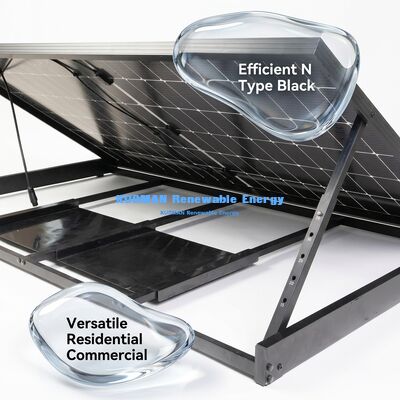
30mm Ultra Slim Solar Panel IP65 Clean Renewable Solar Energy Solar Panel
30mm Ultra-Slim Solar Panel - Sleek Design clean renewable solar energy for home, commercial, travel, car etc

Operating Conditions
Maximum System Voltage
1000V/1500V DC
This indicates the maximum voltage the system can handle. The choice between 1000V and 1500V depends on the specific configuration and application (e.g., residential vs. commercial solar systems).
Temperature Range
-40°C to +85°C
The system is designed to operate efficiently in extreme temperatures, making it suitable for a wide range of climates, from freezing cold to hot desert environments.
Series Fuse Rating
15A
This is the maximum current rating for the fuse used in the system to protect against overcurrent conditions.
NOCT (Nominal Operating Cell Temperature)
45±2℃
NOCT is the temperature at which the solar cells operate under standard conditions (800 W/m² irradiance, 20°C ambient temperature, and 1 m/s wind speed). This value helps estimate the real-world performance of the system.
Temperature Coefficients
| Parameter |
Value |
Description |
| Temperature Coefficient of Isc (α-Isc) |
+0.033%/℃ |
This indicates how the short-circuit current (Isc) changes with temperature. A positive value means the current increases slightly as temperature rises. |
| Temperature Coefficient of Voc (β-Voc) |
-0.29%/℃ |
This shows how the open-circuit voltage (Voc) changes with temperature. A negative value means the voltage decreases as temperature rises. |
| Temperature Coefficient of Pmax (γ-Pmp) |
-0.39%/℃ |
This reflects how the maximum power output (Pmax) changes with temperature. A negative value means the power output decreases as temperature increases. |
KUOMAN Case
Packing Details
Standard Packing Options
- 1pc, 2pcs, 5pcs, 10pcs, or 25pcs per carton/pallet
These options are designed to accommodate different order sizes and ensure safe transportation.
Custom Packing
Individual packing requirements are acceptable.
If you have specific packing needs (e.g., additional padding, special labeling, or unique carton sizes), the supplier can accommodate your requests.
Frequently Asked Questions (FAQ)
Q: How does the wind and snow load rating benefit my project?
A: High load ratings mean reduced risk of structural failure and lower insurance premiums. They allow for fewer mounting attachments in some designs, potentially lowering installation costs while ensuring compliance with strict local building codes in hurricane-prone or heavy snowfall regions.
Q: Why is a low-temperature coefficient important?
A: Solar panels operate hotter than ambient air. A lower power temperature coefficient (like our -0.39%/°C) means the panel loses less efficiency on hot days. This results in a higher annual energy yield compared to panels with a standard coefficient, improving your project's financial returns.
Q: Are these panels suitable for integration with energy storage systems?
A: Absolutely. The stable high-voltage output and robust performance across temperatures make them an excellent, predictable energy source for charging battery systems, both for large-scale commercial storage and off-grid hybrid applications.




 English